
Whirlabout
by Elora Pfriender
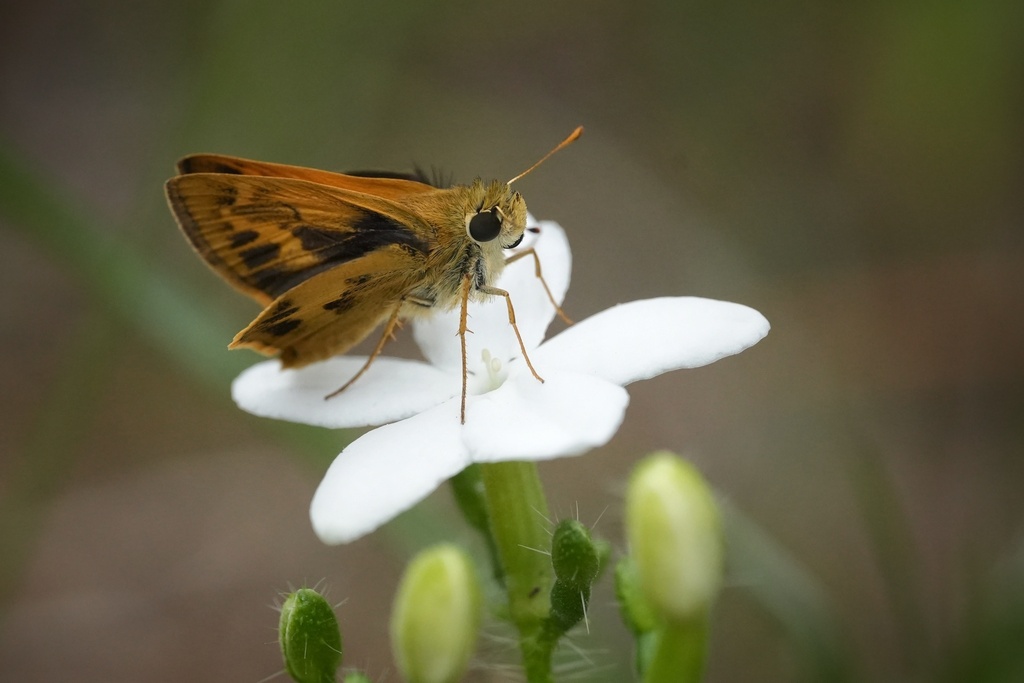
“Know your native pollinators” is a series of articles that will help you identify and appreciate Florida’s varied pollinators, including bees, wasps, butterflies, moths, beetles, flies, birds and bats. Pictured above: Whirlabout (Hedone vibex) on Tread-softly (Cnidoscolus stimulosus) by Emily Bell.
Named for its frantic flight patterns, the Whirlabout is one of several tiny skippers that can be found “whirling” through wildflower patches across the state.
CLASSIFICATION
Class: Insecta
Order: Lepidoptera
Superfamily: Papilionoidea
Family: Hesperiidae
Genus species: Hedone vibex
DID YOU KNOW?
The Whirlabout has weathered several taxonomic changes — not just skippers’ relatively recent inclusion in the superfamily Papilionoidea. As of 2019, researchers have argued that, based on morphological similarities and genetic divergence within the family Hesperiidae, the Whirlabout belongs in the newly expanded genus Hedone — previously just a subgenus — rather than Polites,where it had long been classified.Consequently, Polites now has a narrower definition. Still, as of 2026, many sources continue to refer to the Whirlabout as Polites vibex and do not recognize the combination Hedone vibex, including the Global Lepidoptera Names Index.
IDENTIFICATION
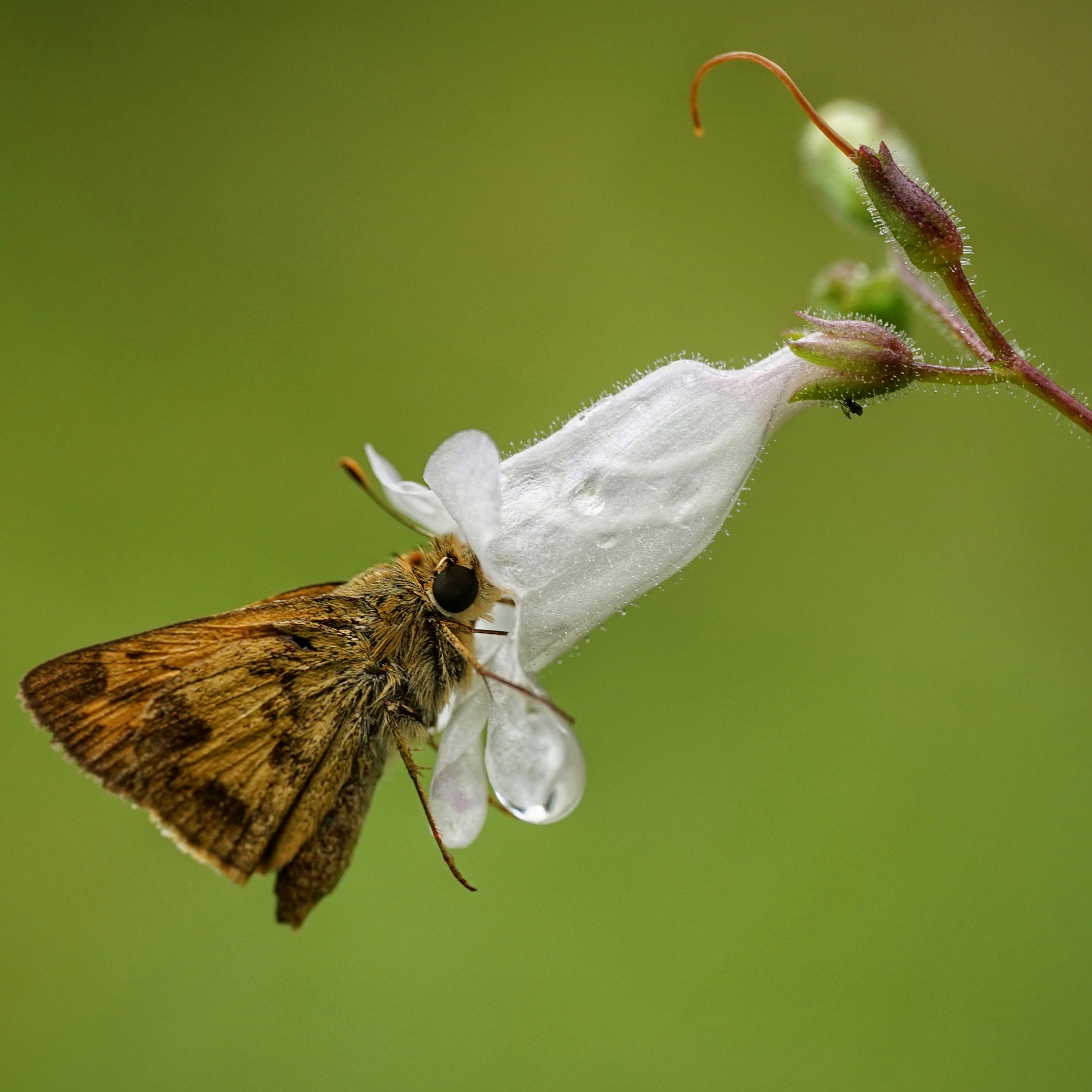
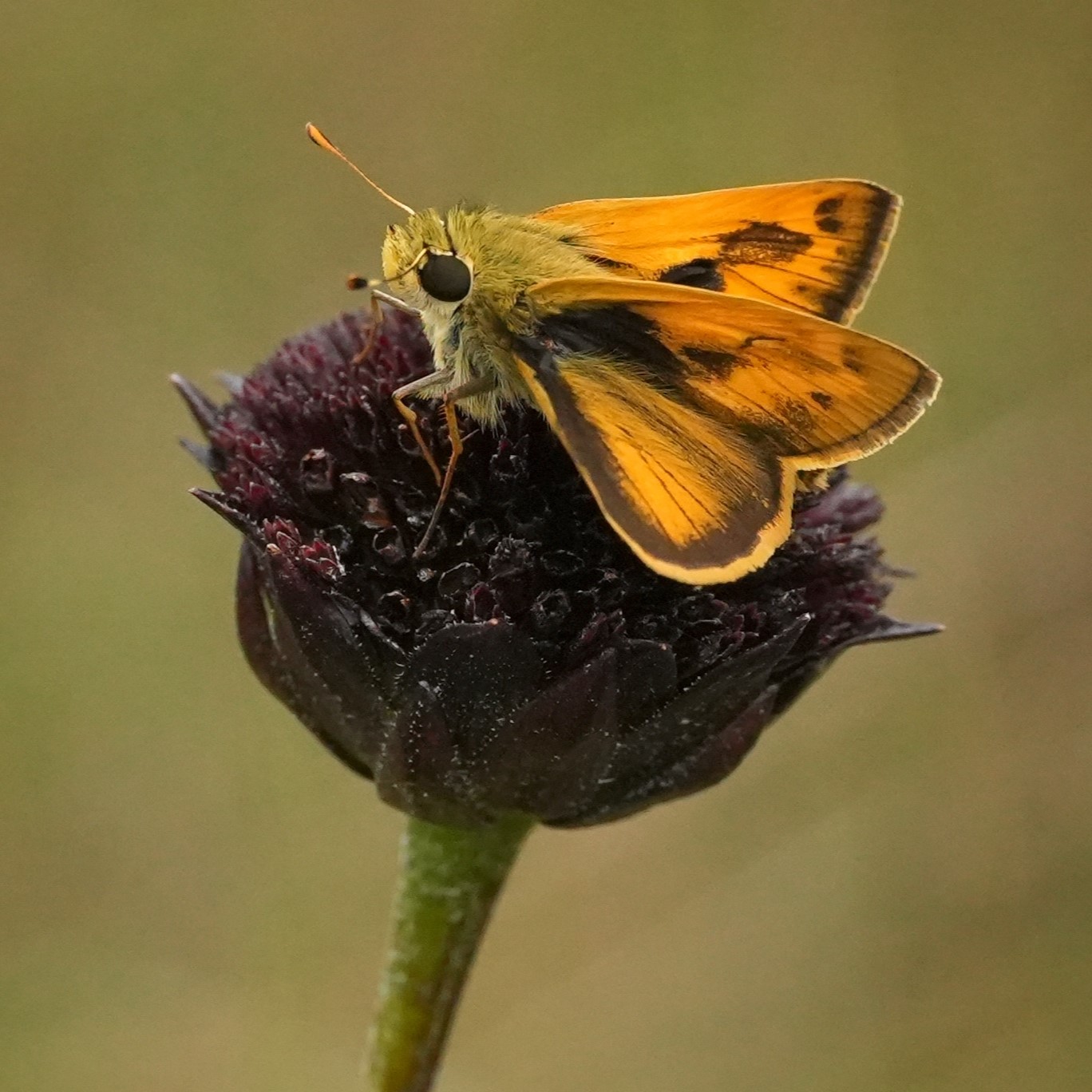
The Whirlabout is a skipper — an insect within the butterfly superfamily Papilionoidea, though skippers were formerly classified separately from both moths and true butterflies prior to modern genetic evidence. Like many skippers native to Florida, the Whirlabout is small (wingspan around 1 to 1.25 inches), fast-flying, and has many lookalikes, making it difficult to distinguish from other species such as the Fiery skipper (Hylephilia phyleus). It can be identified, however, by two rows of subtly larger dark brown markings on the ventral hindwing.
Males and females share the same size and features, but differ in color: males are yellow-orange on the ventral wing surface and bright orange dorsally, while females are entirely brown. Both sexes fly low to the ground in short, erratic bursts — true to their name — with males often resting in grassy areas, waiting for passing females. Whirlabouts are widespread throughout Florida year-round and are also common across the southeastern United States during warmer months.
FORAGING PREFERENCES
Like many skippers, Whirlabouts use tall grasses as larval host plants. Native hosts include crowngrasses (Paspalum spp.), such as Florida paspalum (P. floridanum) and Seashore paspalum (P. vaginatum). They will also utilize non-native species, including Bahiagrass (Paspalum notatum) and Bermuda grass (Cynodon dactylon).
Adults feed on a wide variety of nectar-rich wildflowers in grassy areas and have been observed on Lantana (Lantana depressa), Mistflower (Conoclinium coelestinum), Purple coneflower (Echinacea purpurea) and various native asters (family Asteraceae) like goldenrods (Solidago spp.) and ironweeds (Vernonia spp.).
HABITAT
The Whirlabout can be found throughout Florida year-round, as well as along the southeastern U.S. coast in warmer months. Some populations may extend as far west as Texas and south through Mexico and Central America. On sunny days, look for them along roadsides and in suburban yards and gardens, as well as in forests and sand pine scrub.
LIFE CYCLE
Female Whirlabouts lay white, hemispherical eggs singly on tall blades of grass. Larvae hatch in three broods per year — spring, summer and fall — climbing to the tops of the blades and spinning silk shelters between them to feed on the host plant in relative safety. These larvae are pale green to brown with smooth bodies and dark brown heads. To pupate, they descend the host plants and construct a new shelter at its base, where the chrysalis forms, protected from predators. Adults emerge toward the end of the season to mate and start the next brood.
References:
- Lotts, Kelly, and Thomas Naberhaus. “Whirlabout.” Butterflies and Moths of North America, July 2026. Map
- Meyer, Gwen. “Florida Paspalum.” USDA NRCS Plant Fact Sheet, Feb. 2002
- Ollerenshaw, Justin. “Global Lepidoptera Names Index.” Natural History Museum, Dec. 2011
- “Skippers.” Missouri Department of Conservation, March 2024
- “Whirlabout.” Alabama Butterfly Atlas
- Zhang, Jing, Qian Cong, Jinhui Shen, Leina Song, Riley J. Gott, Pierre Boyer, Crispin S. Guppy, Steve Kohler, Gerardo Lamas, Paul A. Opler, and Nick V. Grishin. “Taxonomic discoveries enabled by genomic analysis of butterflies.” The Taxonomic Report of the International Lepidoptera Survey, vol. 10, no. 7, Oct. 2022
- Zhang, Jing, Qian Cong, Jinhui Shen, Paul A. Opler, and Nick V. Grishin. “Changes to North American Butterfly Names.” The Taxonomic Report of the International Lepidoptera Survey, vol. 8, no. 2, Nov. 2019