
Taxonomy Update: A Hibiscus by Any Other Name
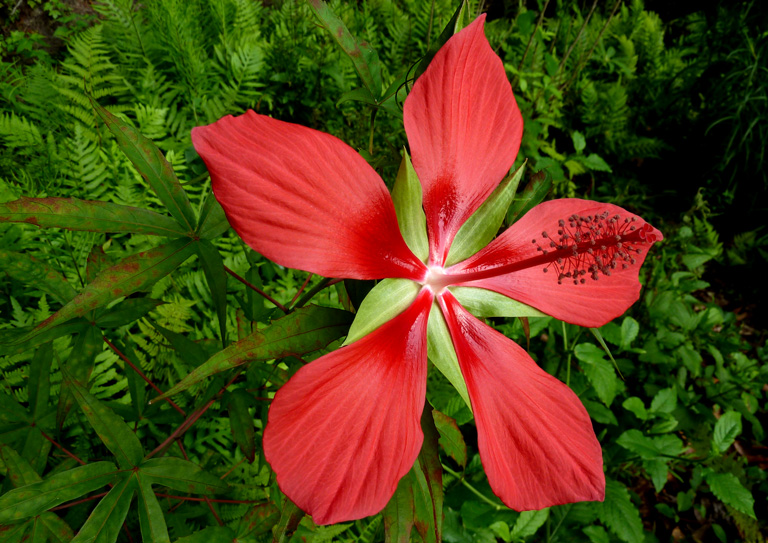
Florida’s native hibiscus and rosemallows are iconic across our natural landscapes and, in more recent years, have begun to gain popularity in community and home landscapes, as well. Members of the Malvaceae family, these plants include 36 native species in Florida – six of which were previously placed in the genus Hibiscus. That changed with the publication of “The hardy Hibiscus—still hardy, but no longer Hibiscus: Reinstatement of Muenchhusia” by the Journal of the Botanical Research Institute of Texas in December 2025. This paper proposed splitting Florida’s Hibiscus into Muenchhusia and Sabdariffa. The changes have been widely accepted by the botanical community: the Atlas of Florida Plants has already made the appropriate updates, and the Flora of the Southeastern United States plans to do so this year.
Why Does This Work Matter?
Taxonomic changes — especially for well-known species — can be frustrating and hard to keep up with, but they reflect the work of dedicated scientists striving to better understand the evolutionary relationships of the flora and fauna around us. In recent decades, more accurate and accessible genetic analysis tools have allowed our taxonomies to be greatly refined.
In the case of Hibiscus, botanists have long recognized it as a polyphyletic group, meaning species were grouped based on shared morphological features that were the result of convergent evolution rather than a common ancestry. Splitting the genus is an effort to create smaller monophyletic groups, in which all species descend from a specific common ancestor. An alternative approach would be to make Hibiscus monophyletic by greatly increasing it, lumping in additional genera to create a much larger evolutionary tree. Botanist Alan Weakley has noted that neither solution feels ideal, but that splitting is likely the better path forward — a view that appears generally agreed upon across the botanical community.
What’s in a Name?
These changes in nomenclature represent a reinstatement of genera that were previously lumped into Hibiscus, governed by the naming rules established in the International Code of Nomenclature for algae, fungi and plants. Muenchhusia was first published by Philipp Conrad Fabricius in 1763 and honors the German botanist Otto von Münchhausen. Sabdariffa was first published in the Allgemeine Medizinisch-Pharmazeutische Flora in 1836. Its etymology remains uncertain, with two prevailing theories: some believe it has roots in Caribbean dialects, while others believe it is comes from the Turkish language.
Guide to the New Nomenclature:
|
Common Name |
Previous Scientific Name: |
Updated Scientific Name: |
|
Scarlet hibiscus |
Hibiscus coccineus |
|
|
Swamp rosemallow |
Hibiscus grandiflorus |
|
|
Halberdleaf rosemallow |
Hibiscus laevis |
|
|
Crimsoneyed rosemallow |
Hibiscus moscheutos |
|
|
Comfortroot |
Hibiscus aculeatus |
|
|
Lindenleaf rosemallow |
Hibiscus furcellatus |
NOTE: One species not addressed by this work was the endemic, state-endangered Poeppig’s rosemallow (Hibiscus poeppigii), which for now stands alone as Florida’s only species in the genus Hibiscus.
As a science-based organization, the Foundation has updated its resources to reflect the latest accepted research.