

Giant swallowtail
by Elora Pfriender
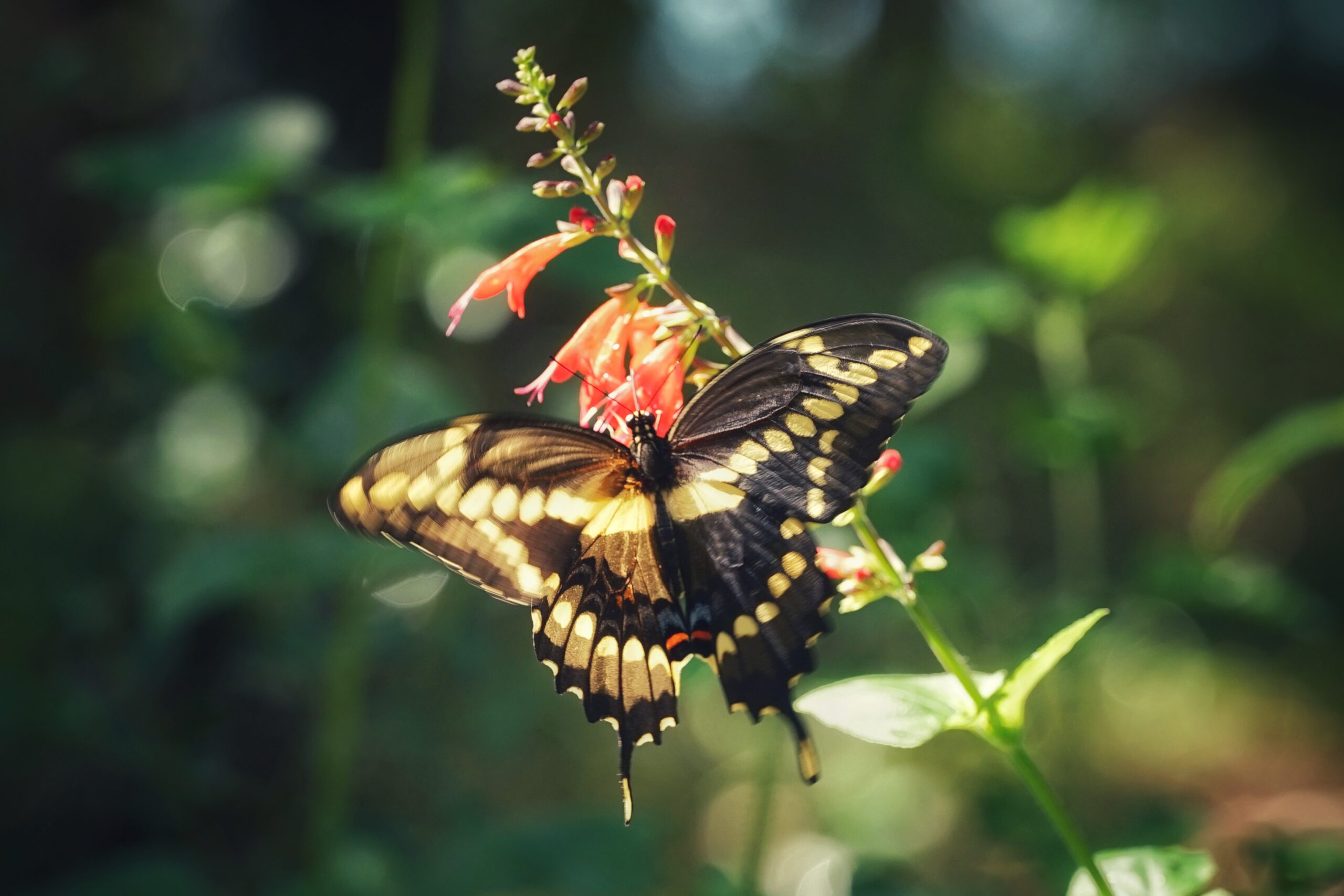
“Know your native pollinators” is a series of articles that will help you identify and appreciate Florida’s varied pollinators, including bees, wasps, butterflies, moths, beetles, flies, birds and bats. Pictured above: Giant swallowtail (Papilio cresphontes) on Tropical sage (Salvia coccinea) by Emily Bell.
From its wingspan to its range across the Americas — and even its appetite for oranges — everything about the Giant swallowtail is just that: giant!
CLASSIFICATION
Class: Insecta
Order: Lepidoptera
Family: Papilionidae
Genus species: Papilio cresphontes
FUN FACT
When threatened, like other swallowtail larvae, they can extrude a usually inverted organ called the osmeterium, which resembles intimidating horns or the forked tongue of a snake and emits an acidic repellent to fend off foes.
IDENTIFICATION
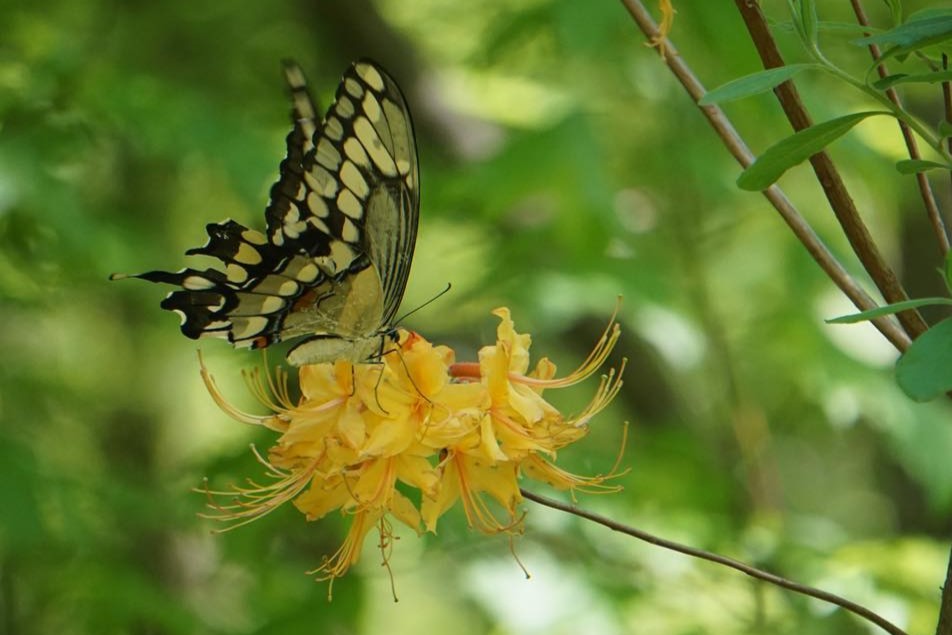
Photo by Betsy Harris
Spread throughout most of North America, the Giant swallowtail is easily identifiable as the largest butterfly in the United States and one of the largest in the entire Western Hemisphere. Females are often slightly larger than males, but wingspans averaging well over 5 inches are seen in both sexes.
The Giant swallowtail may be confused with large females of the similarly colored Eastern tiger swallowtail (Papilio glaucus) or even the endangered Schaus’ swallowtail (Heraclides aristodemus ponceanus), which is endemic to southern Florida and the Keys. However, the Giant swallowtail is distinguished by its mostly black dorsal coloration with yellow banding, as well as small red patches on the ventral hindwing.
FORAGING PREFERENCES
Flowering plants in the citrus and rue family (Rutaceae) serve as host plants for the Giant swallowtail. In Florida, this often means the species makes its home among the many non-native trees cultivated for fruit, such as Sweet orange (Citrus × sinensis) and other hybrids in the genus Citrus. However, several native Rutaceae species also serve as hosts, including Wild lime (Zanthoxylum fagara), Torchwood (Amyris elemifera), Wafer ash (Ptelea trifoliata) and Hercules club (Zanthoxylum clava-herculis).
In addition to the flowers of these host trees, adults may nectar on a wide variety of other blooms, including native species of azaleas (Rhododendron spp.), goldenrods (Solidago spp.), milkweeds (Asclepias spp.), bee balms (Monarda spp.) and asters.
HABITAT
The Giant swallowtail is common throughout Florida year-round, although its flight in northern parts of the state may be limited during colder months. When they are around, though, these large, gliding butterflies are hard to miss. They may be seen sailing smoothly through citrus groves, where they often lay their eggs and may even be considered pests, or rapidly fluttering their wings as they nectar on garden flowers.
DID YOU KNOW?
Giant swallowtail caterpillars are sometimes also called “orangedogs” because of their ravenous appetites for citrus leaves, which can quickly defoliate young trees — making them common pests in Florida’s commercial orange groves. Although you might not be able to guess their fruit of choice by looking at larvae or adults, Giant swallowtail eggs are round and coated in a rough, orange-colored film, making them resemble tiny oranges.
LIFE CYCLE
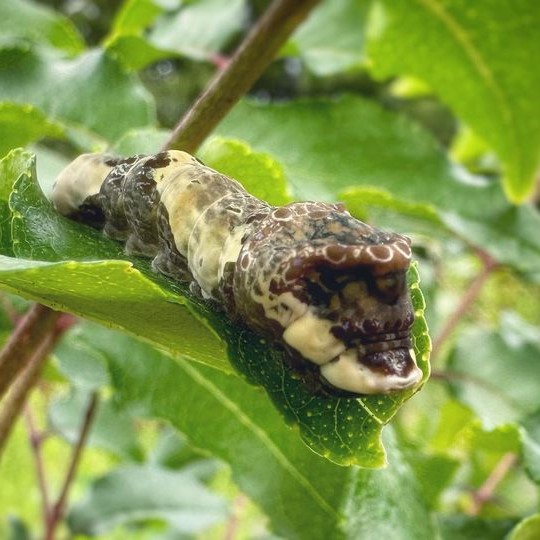
Photo by Emily Bell
Females lay spherical, orange-brown eggs singly on the tops of tree leaves. Like the caterpillars of other swallowtails, young Giant swallowtail larvae exhibit bird-dropping mimicry (black with white markings) to avoid predation, allowing them to rest safely on leaf surfaces during early stages of larval development. More mature larvae may rest on leaf stems or twigs; this is also where they will pupate, taking on a brown twig-like appearance of their own.
References:
- Diepenbrock, L. M., K. L. Ray, and J. D. Burrow. “Citrus Pest Quick Guide: Orangedog (Papilio cresphontes).” Ask IFAS, Feb. 2024
- Daniels, Jaret C. “Schaus Swallowtail, Heraclides aristodemus ponceanus (Schaus) (Insecta: Lepidoptera: Papilionidae).” Ask IFAS, Dec. 2014
- “Giant Swallowtail.” Alabama Butterfly Atlas
- “Giant Swallowtail.” Illinois Department of Natural Resources
- Hall, Donald W., and Jerry F. Butler. “Tiger Swallowtail, Eastern Tiger Swallowtail, Papilio glaucus Linnaeus (Insecta: Lepidoptera: Papilionidae).” Ask IFAS, Nov. 2024
- McAuslane, H. J. “Giant Swallowtail, Orangedog, Papilio cresphontes Cramer (Insecta: Lepidoptera: Papilionidae).” Ask IFAS, April 1997