
Feather-legged scoliid wasp
by Elora Pfriender
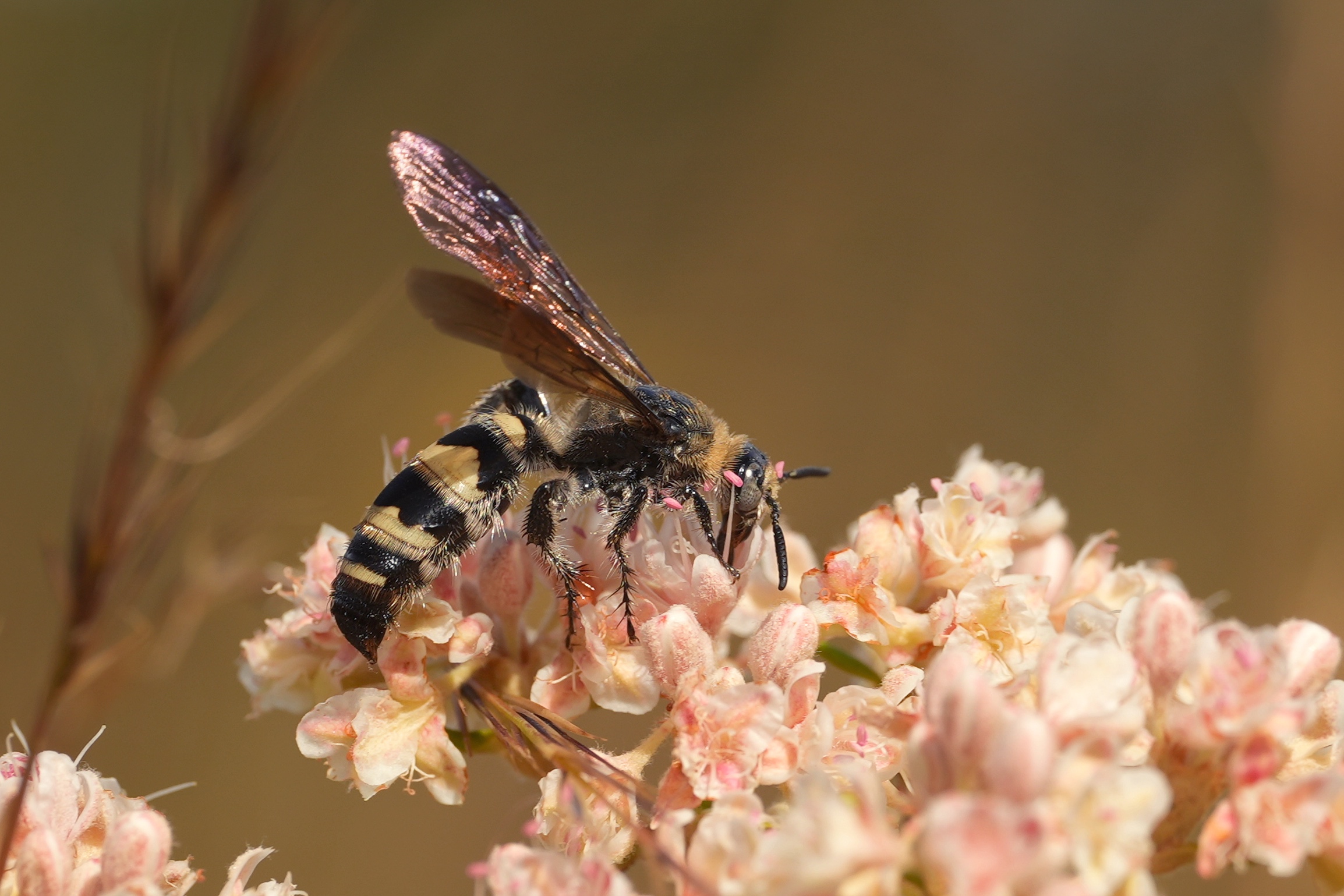
“Know your native pollinators” is a series of articles that will help you identify and appreciate Florida’s varied pollinators, including bees, wasps, butterflies, moths, beetles, flies, birds and bats. Pictured above: Feather-legged scoliid wasp (Dielis plumipes) on Dogtongue wild buckwheat (Eriogonum tomentosum) by Emily Bell.
Feather-legged scoliid wasps are commonly seen pollinating wildflowers in pine flatwoods and sandhills throughout summer and fall.
CLASSIFICATION
Class: Insecta
Order: Hymenoptera
Family: Scoliidae
Genus species: Dielis plumipes
DID YOU KNOW?
Feather-legged scoliid wasps are solitary, not hive insects, and live in burrows in the soil. Females may dig these burrows themselves using their mandibles, forelegs and midlegs, or they may track down scarab beetle larvae and claim the hosts’ burrows for themselves.
IDENTIFICATION
The Feather-legged scoliid wasp is a sexually dimorphic, black-and-yellow banded wasp Both sexes are about the same length (15–25 mm), but females have wider abdomens and extra setae, or “hairs,” around the base of the head. These wasps occur commonly throughout the eastern, central and midwestern United States, where they are divided into three geographically distinct subspecies. Florida’s Feather-legged scoliid wasps belong to the southeastern subspecies, D. plumipes fossulana, which can also be set apart from other populations by its thinner yellow bands. Subspecies do not co-occur in Florida.
FORAGING PREFERENCES
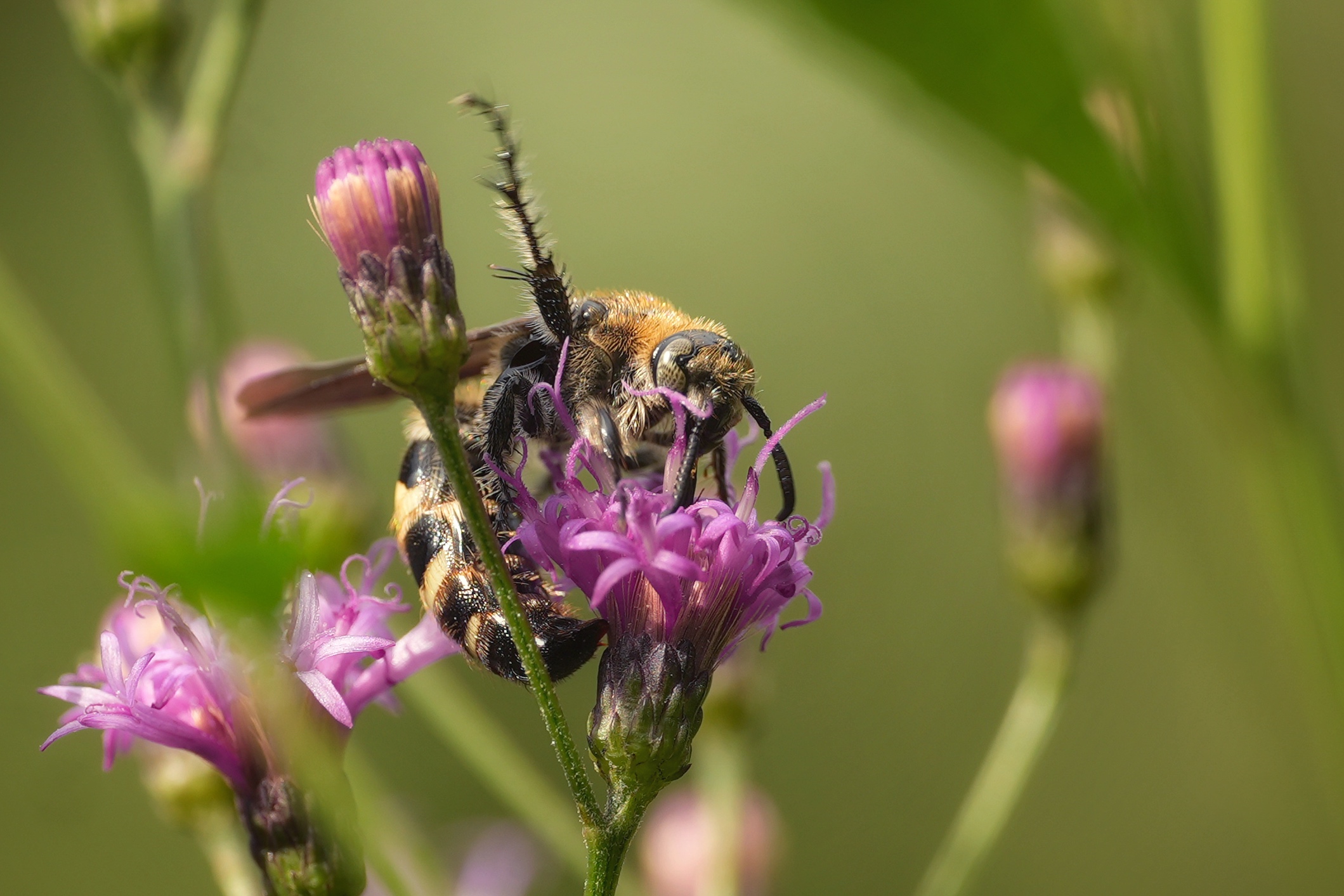
Like all members of the family Scoliidae, Feather-legged scoliid wasps are parasitoids, most commonly laying their eggs on scarab beetle grubs (family Scarabaeidae). In early summer, adult wasps may be seen nectaring on a variety of flowers, including native goldenrods (Solidago spp.) and rattlesnakemasters (Eryngium spp.).
HABITAT
The Feather-legged scoliid wasp is common in Florida, and populations may span as far north as New York and as far west as the Rocky Mountains. Because of their parasitoid life cycle, scoliid wasps are found only near scarab beetle habitat. Adults are most often seen in early summer. Males commonly rest on flowers or fly in low figure-eight patterns, while females fly low to the ground in search of beetle larvae to host their eggs. Feather-legged scoliid wasps are day-flying pollinators, retreating into burrows in the soil at night.
LIFE CYCLE
After an adult female Feather-legged scoliid wasp finds a suitable host larva, she stings and paralyzes it before laying her eggs. The grub may soon recover from its paralysis and move as normal until the wasp larvae hatches and begins to eat it. The wasp then pupates over the winter and emerge as an adult early the following summer. Even if the female does not lay eggs, the grub will eventually die from the sting. Scoliid wasps rarely sting humans, and smaller species are sometimes released as a form of natural pest control.
References:
- Brandenberg, R. “Scoliid Wasps in Turf.” NC State Extension, 2017
- “Dielis plumipes ssp. fossulana.” iNaturalist
- Grissell, E. E. “Scoliid Wasps of Florida, Campsomeris, Scolia and Trielis spp. (Insecta: Hymenoptera: Scoliidae).” UF/IFAS Extension, June 2007
- Schuh, M. “Parasitoid wasps.” University of Minnesota Extension, 2026
- “Species Dielis plumipes – Feather-legged Scoliid Wasp.” BugGuide
- Szafranki, P. “Alloreferent and Apparent Seasonal Polyphenism of Dielis tejensis with an Updated Key to Nearctic Dielis Species (Hymenoptera: Scoliidae).” Insects, vol. 17, no. 3, 2026
- Watts, S. “Two-Spotted Scoliid Wasp: A Gentle and Valuable Garden Visitor.” Clemson Cooperative Extension, 2025