
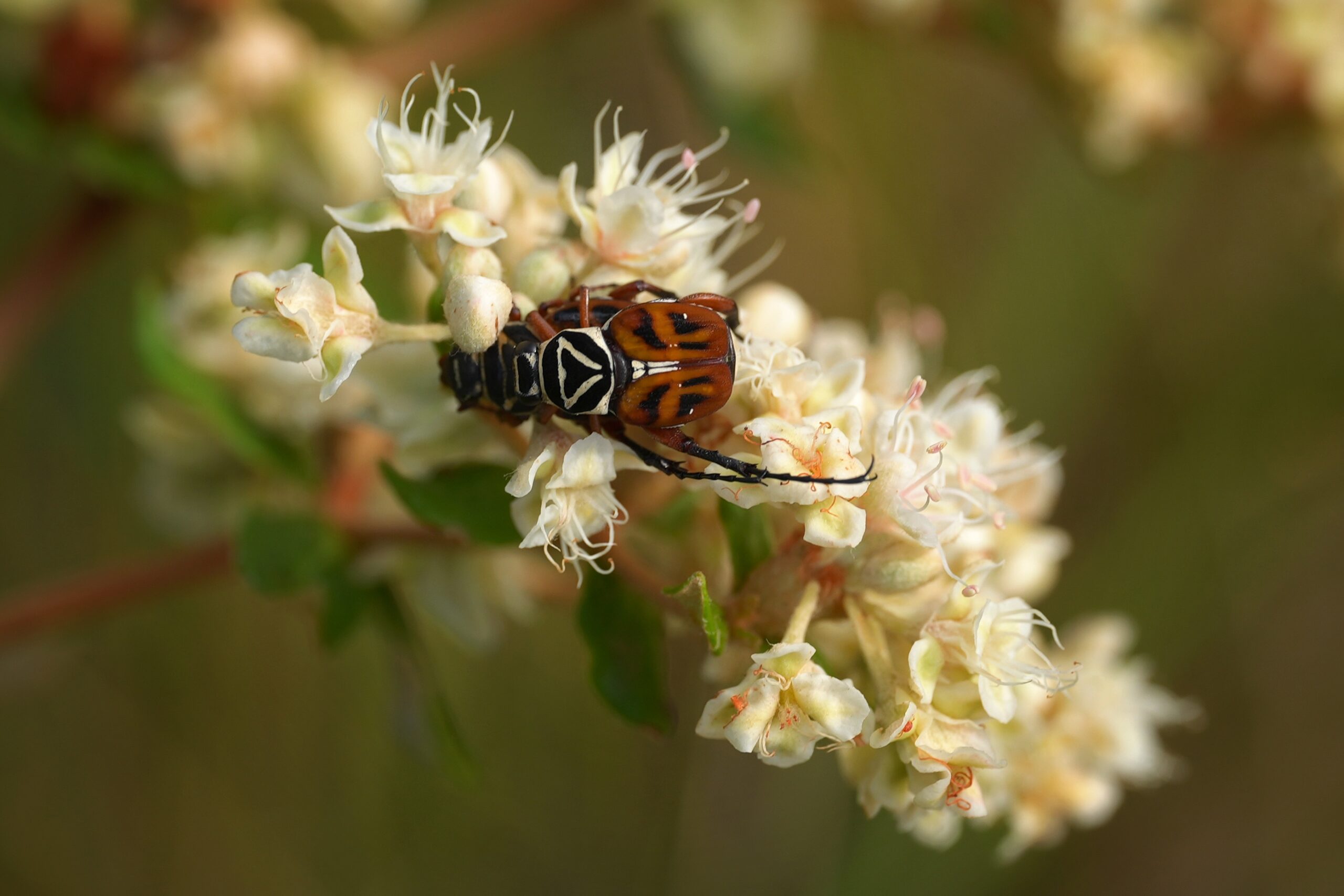
Delta flower scarab beetle
by Elora Pfriender
“Know your native pollinators” is a series of articles that will help you identify and appreciate Florida’s varied pollinators, including bees, wasps, butterflies, moths, beetles, flies, birds and bats. Pictured above: Delta flower scarab beetle (Trigonopeltastes delta) on Dogtongue wild buckwheat (Eriogonum tomentosum) by Emily Bell.
When you think of pollinators, a beetle might not immediately come to mind — but these insects are even more reliant on flowers than some bees and butterflies.
CLASSIFICATION
Class: Insecta
Order: Coleoptera
Family: Scarabaeidae
Genus species: Trigonopeltastes delta
FUN FACT
While both larvae and adult Delta flower scarab beetle are completely harmless to humans, plants and potential predators alike, their bright yellow markings against a reddish-brown thorax may mimic the coloration of wasps — such as yellowjackets, hornets and paper wasps (Vespidae family) — as a way to ward off would-be predators.
IDENTIFICATION
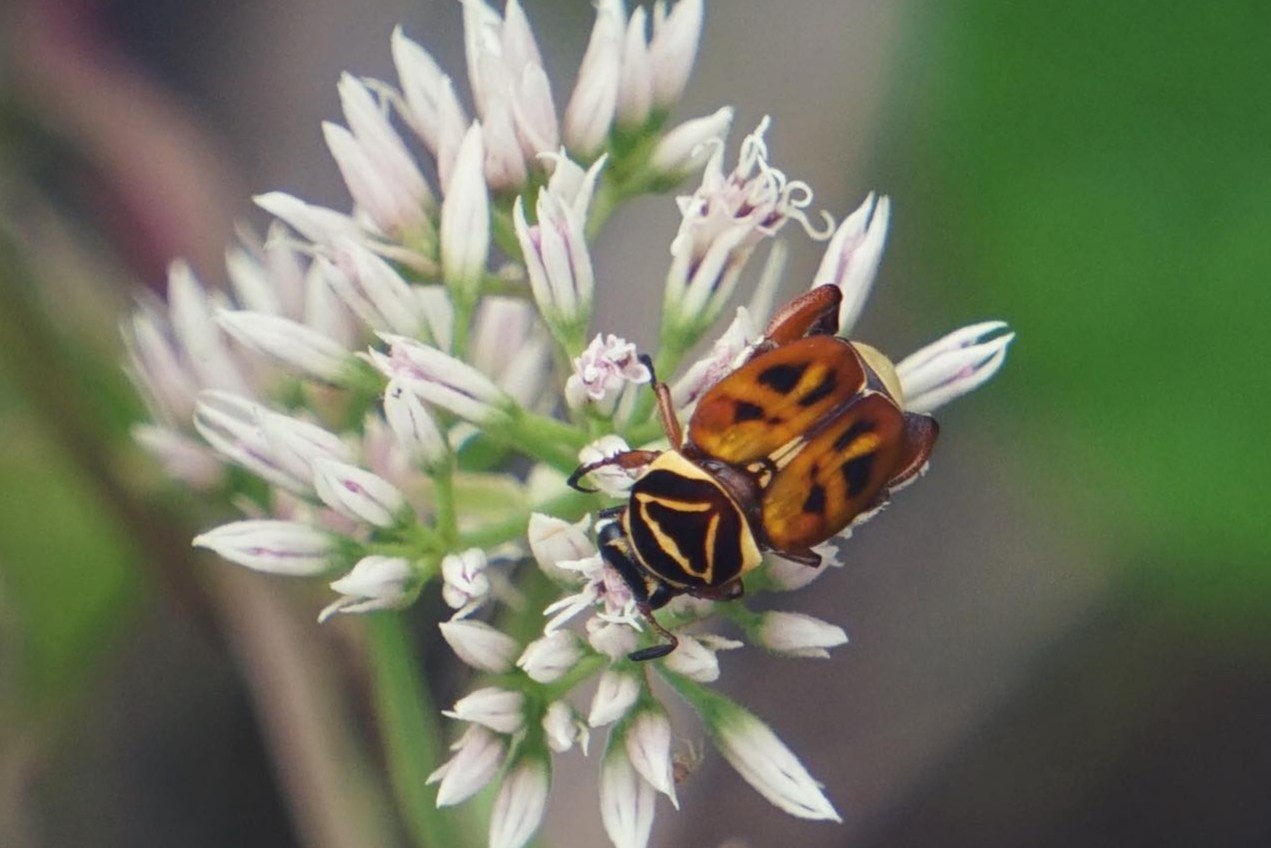
Photo by Emily Bell
As its name suggests, the Delta flower scarab beetle is best identified by the triangular yellow marking on the pronotum (the foremost part of the thorax) that resembles the Greek letter Δ or “delta.” Females tend to have brighter, shinier coloration than males. However, males are far more common. Regardless of sex, adult Delta flower scarab beetles are typically around 8–11 mm long, with thin abdomens around 3–4 mm at the widest.
This species (T. delta) can be distinguished from the only other Trigonopeltastes found in Florida — the much rarer T. floridana — by its prevalence throughout the southeastern United States and its more pronounced triangular marking. T. floridana appears to be largely limited to north-central Florida and bears a U- or V-shaped pronotal marking. Interestingly, in T. floridana, females are far more common than males — the opposite of T. delta.
FORAGING PREFERENCES
Like other flower beetles (subfamily Cetoniinae), Delta flower scarab beetles are herbivores with small mandibles, relying on the pollen, sap and rotting fruit of flowering plants. They can be found feeding and mating on a wide variety of flowers in Florida, including native plants such as Buttonbush (Cephalanthus occidentalis), Sabal palm (Sabal palmetto), Tall elephantsfoot (Elephantopus elatus), Winged sumac (Rhus copallinum), goldenrods (Solidago sp.), magnolias (Magnolia sp.) and morning glories (Ipomoea sp.).
HABITAT
The Delta flower scarab beetle is widespread in the southeastern United States and quite common throughout Florida. Adult beetles can be found feeding on flowers from May through August in open grassy fields and prairies.
LIFE CYCLE
Many flower beetles remain understudied or even undescribed, and researchers lack direct evidence of every stage of the Delta flower scarab beetle’s life cycle. That said, it likely follows a pattern similar to flower beetles: in summer, females lay tiny, oval-shaped white eggs in the ground, where the larvae will hatch and overwinter in the soil. Beetles spend the majority of their year-long lifespan as larvae —likely passing through three instars. When temperatures warm, they pupate in late spring and emerge as adults in early summer.
References:
- Harrison, Les. “Delta Flower Scarab Beetle is Master of Disguise.” UF/IFAS Extension Wakulla County, Oct. 2015
- Jones, Brandon, and Andrea Lucky. “Delta Flower Beetle Trigonopeltastes delta (Forster 1771) (Insecta : Coleoptera : Scarabaeidae : Cetoniinae : Tribe, Trichiini).” UF/IFAS Extension, April 2018
- “Vespidae (yellowjackets, hornets, paper wasps, etc).” Ask IFAS
- Woodruff, Robert E. “Suppression of the Genus Ropsila Casey with Notes on the United States Species of Trigonopeltastes Burmeister (Coleoptera: Scarabaeidae).” The Florida Entomologist, vol. 43, no. 3, Sept. 1960